
Medicare Negotiation Program Deselection: Analysis of Previously Deselected Drugs and Likely Fall 2026 Targets
Authored by Allison Schneider, MHA, and Lindsay Bealor Greenleaf, JD, MBA
Under the Inflation Reduction Act, drugs selected for the Medicare Drug Price Negotiation Program may be ‘deselected’ once a generic or biosimilar is “marketed” pursuant to its approval or licensure. In guidance and rulemaking, the Centers for Medicare and Medicaid Services (CMS) has interpreted this standard to require “bona fide marketing” of at least one generic or biosimilar for any dosage form or strength of the selected drug. CMS stresses that a determination of bona fide marketing is a “holistic” evaluation based on the “totality of the circumstances.” Although the agency has not provided any threshold or range for when a generic or biosimilar will be deemed “bona fide marketed,” it has specified the data sources and factors it will consider.
These factors include whether the generic or biosimilar is “regularly and consistently” available for purchase, the existence of any agreements that may limit the availability or distribution of the generic or biosimilar, and other available information on market share and competition. CMS’s approach to the data sources the agency will review when making a deselection determination has evolved to include Prescription Drug Event (PDE) data, Average Manufacturer Price (AMP) data, Average Sales Price (ASP) data, Medicaid State Drug Utilization Data (SDUD), and commercial databases.
In recent rulemaking, CMS provided examples of a positive bona fide marketing determination: (1) generics or biosimilars with “high and consistent” utilization, and (2) newly launched generics or biosimilars with low utilization but no apparent commercialization barriers. In contrast, CMS noted that generics or biosimilars with no utilization and/or ongoing barriers to commercialization (i.e., due to patent disputes) would not meet the standard for bona fide marketing.
Prior Deselection Announcements
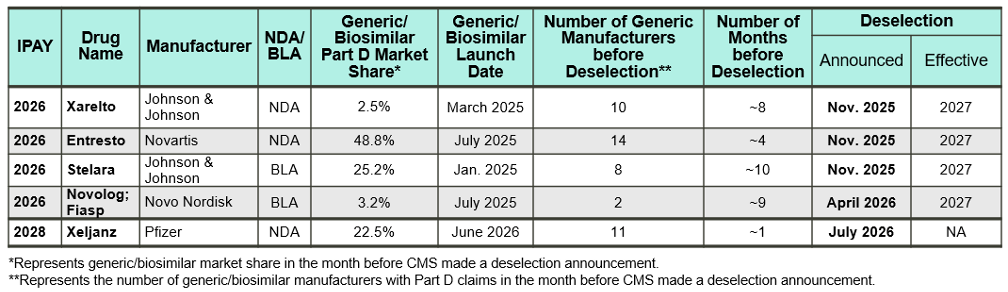
As of publication of this article, CMS has deselected five products. In November 2025, CMS announced the deselection of Xarelto, Entresto, and Stelara. In April 2026, CMS announced the deselection of Novolog/Fiasp. These four drugs were deselected outside their Negotiation Period (i.e., the formal negotiation period with CMS had ended) and will have a Maximum Fair Price (MFP) apply for one year based on CMS guidance. In July 2026, CMS announced the deselection of Xeljanz. Because CMS deselected Xeljanz before the end of its Negotiation Period (i.e., before November 1, 2026), an MFP will not apply.
Analysis of Previously Deselected Drugs
To better understand CMS’s deselection decisions, ADVI Health analyzed Part D market share and other qualitative factors for the five drugs deselected to date. Consistent with CMS guidance for Initial Price Applicability Years (IPAYs) 2026, 2027, and 2028, ADVI examined Part D claims data through the month before CMS made each deselection announcement.[1]
Xarelto (rivaroxaban; Johnson & Johnson)
CMS deselected Xarelto approximately 8 months after generics launched in March 2025. Notably, generics launched for the 2.5 mg strength dosage form of rivaroxaban, but not for all other higher dosage forms used for additional indications of Xarelto. In October 2025, the month prior to the deselection announcement, there were 10 generic manufacturers with Part D claims accounting for a combined total of 2.5% of Part D market share for that month.
Entresto (sacubitril/valsartan; Novartis)
CMS deselected Entresto 4 months after generics launched in July 2025. These launches occurred shortly after patent litigation was decided in favor of generic manufacturers. By October 2025, 14 generic manufacturers had Part D claims, which accounted for nearly 50% of Part D market share.
Stelara (ustekinumab; Johnson & Johnson)
Patent settlement agreements allowed ustekinumab biosimilars to launch throughout 2025, starting in January. At the time of CMS deselection in November 2025, 10 months after the initial biosimilar launch, there were 8 manufacturers with ustekinumab Part D claims, making up approximately 25% of Part D market share. This is significantly higher than the market wide mean of 8% biosimilar market share, with 1 – 3 biosimilar manufacturers, by the third quarter after initial launch.
Novolog, Fiasp (insulin aspart, human; Novo Nordisk)
While insulin aspart biosimilars launched in July 2025, CMS notably did not deselect Novolog/Fiasp that November, although it deselected another product with generics that launched on a similar timeline (Entresto). In October 2025, one biosimilar manufacturer had Part D claims accounting for 0.3% of total insulin aspart Part D market share. By March 2026, the month prior to deselection, a second biosimilar had launched, and total biosimilar market share was 3.2%.
Xeljanz (tofacitinib; Pfizer)
Xeljanz is the only drug to be deselected within its Negotiation Period and was deselected within the shortest timeframe compared to the other 4 deselected drugs. Generic tofacitinib launched in the United States in early June 2026, and CMS announced Xeljanz’s deselection on July 28, 2026. Per IPAY 2028 Final Guidance, CMS likely used PDE from June (and potentially part of July) for its determination. In June, generics accounted for 22.5% of tofacitinib Part D claims.
Summary: Deselected Drugs
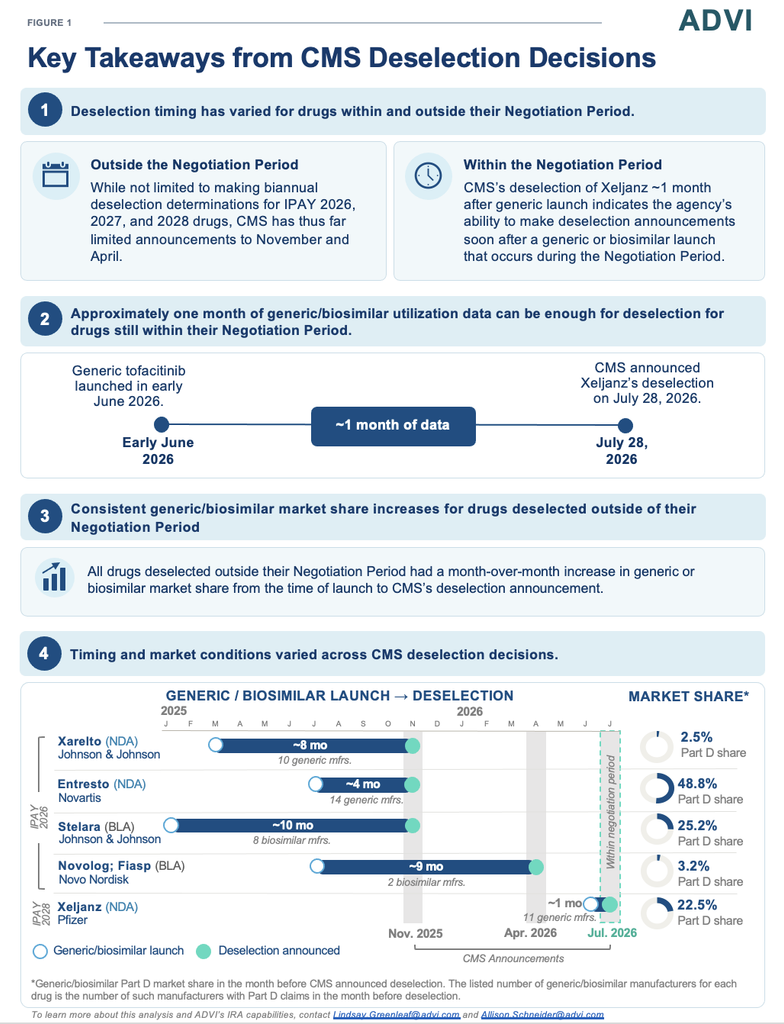
Deselection timing has varied for drugs within and outside their negotiation period.
Within Negotiation Period: Xeljanz’s deselection in July 2026, just one month after generics launched, demonstrates CMS’s ability and willingness to make deselection announcements soon after a generic or biosimilar launch that occurs during the Negotiation Period. This quick timing is especially critical for such drugs, as a deselection announcement made by November 1 within the Negotiation Period prevents a Selected Drug’s MFP from going into effect.
Outside Negotiation Period: For drugs outside their Negotiation Period, deselection timing may be influenced by CMS’s review calendar rather than market activity. The number of months between generic or biosimilar launch and deselection ranged from 4 to 10 months. However, this is likely not indicative of CMS waiting for utilization to increase to a specific benchmark given the range in generic and biosimilar Part D market share. While not limited to making biannual deselection determinations for IPAY 2026, 2027, and 2028 drugs outside their Negotiation Period, CMS has limited announcements to November and April thus far. This also aligns with CMS’s proposed approach to deselection for drugs outside their Negotiation Period in the Negotiation Program Proposed Rule.[1]
Drugs deselected outside of their negotiation period saw month-over-month increases in market share, but few other common characteristics. All drugs deselected outside their negotiation period had a month-over-month increase in generic or biosimilar market share from the time of launch to CMS’s deselection announcement. However, the amount of increase varied substantially by drug, from several percentage points to nearly half. Generic and biosimilar market share at the time of deselection varied substantially, ranging from the low single percentages to close to 50%. Notably, CMS likely used only one full month of generic market share data when it deselected Xeljanz, the only drug deselected within its negotiation period (per IPAY 2028 Final Guidance, CMS may have used partial data from July).
The number of generic or biosimilar manufacturers with Part D claims also varied. While there were close to or more than 10 generic or biosimilar manufacturers for most deselected drugs, there were only two Novolog/Fiasp biosimilar manufacturers with claims at the time of deselection.
CMS may be more likely to accept lower market share for biosimilars compared to generics when making deselection decisions. Regarding generic and biosimilar market share expectations, the agency deselected two products with generics or biosimilars with less than 5% of Part D market share (Xarelto and Novolog/Fiasp). Two of the three other deselected products were approved under NDAs and had generic Part D market share between 22% and 50%. While Stelara biosimilars achieved 25% market share before deselection, this does align with trends market wide. Historically, median Part D generic market share has risen to nearly 50% within the first month of launch (and approximately 80% six months after entry), while mean biosimilar market share was under 5% the first quarter after launch, and may take up to three years to eclipse the reference product’s market share.[2]
Deselection Projections: Likely Targets for Fall 2026
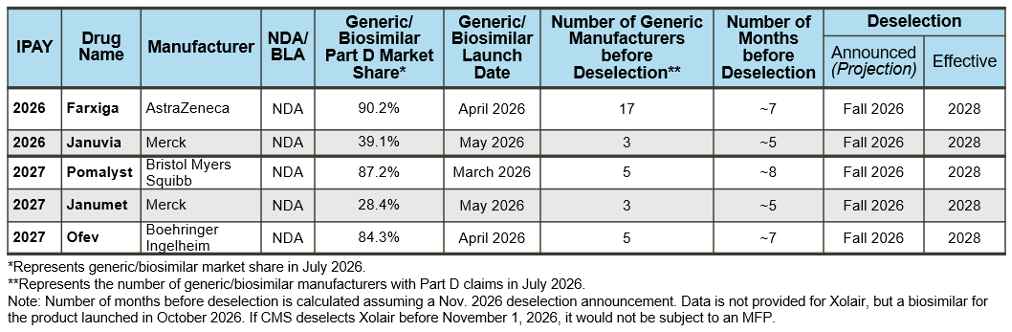
While CMS is not limited to making deselection announcements for IPAY 2026, 2027, and 2028 drugs outside their Negotiation Period in November and April, if this trend continues, there are 5 products likely to be deselected this Fall, as listed below. Generics for these drugs launched between March and May 2026 and accounted for 28 – 90% of Part D market share in July 2026, well above the 2 – 3% market share for some IPAY 2026 deselected products. These projections are based on publicly available launch information and Part D market share data as of July 2026. CMS could deselect other selected drugs in 2026 if generics or biosimilars launch or gain market share earlier than public sources anticipate.
Fall 2026 Deselection Projections
To learn more about ADVI’s Deselection Analysis, broader IRA offerings, or Medicare claims data capabilities, please contact Lindsay Greenleaf, SVP and Head, Market Access Policy Strategy (MAPS) at Lindsay.Greenleaf@advi.com and Allison Schneider, Director, MAPS at Allison.Schneider@advi.com.
[1] IPAY 2026, 2027, and 2028 Final Guidance indicates that CMS will check for bona fide marketing of generics or biosimilars on a monthly basis using the most recent 12-month period for each data source. For IPAYs 2026 and 2027, CMS provides examples of PDE data periods ending the month before the deselection assessment (i.e., for an April 2025 assessment, CMS notes it would use PDE data from April 2024 through March 2025. CMS uses mid-month examples in the IPAY 2028 Final Guidance (i.e., for an April 2026 assessment, CMS notes it would use PDE data from May 2025 to mid-April 2026). Since it is unclear to what extent CMS is making deselection assessments for IPAY 2028 drugs using partial-month data, ADVI used Part D market share from the month before the deselection announcement for Xeljanz.
[2] In the Negotiation Program Proposed Rule (published June 12, 2026), CMS stated that the agency will review data for purposes of deselection as follows: monthly during the Negotiation Period (March – November 1) and biannually in March and October, beginning in October of the calendar year after an MFP agreement is reached. If finalized, these parameters would apply to drugs selected for IPAY 2029 onwards and IPAY 2026, 2027, and 2028 drugs beginning January 1, 2029.
[3] Note: Mean biosimilar market share information is based on historic trends for US commercial plans, not Medicare Part D, and is not specific to pharmacy benefit drugs.
CEO insights
Related articles
Real analysis from people who’ve been there

Exclusive Webinar: Unpacking the Future of U.S. Drug Pricing Policy
Gain immediate access to actionable insights from CMS and ADVI Health policy leaders. From the Medicare Drug Price Negotiation Program …
Analysis of 340B modifier usage in Medicare Part B claims
Analysis of Part B Claims from January 2025 through June 2026 Prepared By:Johanna Celli, Pete Kardel, Caitlin Sheetz, ADVI Health’s …

The 2026 Rare Disease Reality
Orphan drugs now represent approximately 20 percent of total prescription spend, and over 52 percent of the cell and gene …

Marc Samuels, JD, MPH
February 26, 2026

AI in the Patient Care Paradigm: Examining Regulatory Challenges to Clinical Adoption
Artificial intelligence could transform clinical care, but regulatory hurdles slow adoption. Ensuring healthcare AI has adequate policy safeguards is paramount …
Marc Samuels, JD, MPH
December 30, 2025

2026 Life Sciences Forecast: AI, Next-Gen Cell & Gene Therapy, and Policy Disruption
In 2026, we expect the healthcare landscape to be defined by technology breakthroughs, market access disruption, and profound policy changes. …
Marc Samuels, JD, MPH
December 16, 2025

Delivering on CAR T-cell Therapy’s Promise: Policy Solutions for the Next Era of Cancer Care
CAR T-cell therapy offers a groundbreaking treatment option for patients with relapsed or refractory hematologic malignancies, yet access remains severely …

Alicia Silver, MPP
November 21, 2025

The Unintended Consequences of Drug Pricing Policies on Orphan Drug Development
Rare diseases impact nearly 1 in 10 people in the US and are largely untreated, with 95 percent lacking FDA-approved …

ADVI Analysis: HRSA 340B Covered Entity Audits
Analysis of HRSA 340B Covered Entity Audits Since the 340B Drug Pricing Program began in 1992, covered entities’ participation has …
Reach out
Own your edge
We don’t just guide the market. We shape it. Map your market access moves with #ADVIIntelligence. Proven advantage. Unmatched partnership.