
Prevalence and Proportion of Medicare Patients with MDD Receiving Treatment

Caitlin Sheetz, MPH
May 20, 2023
Major Depressive Disorder (MDD) is one of the most common mental disorders in the United States. According to the National Institute of Mental Health (NIMH), an estimated 21 million adults in the United States had at least one major depressive episode in 2020.*
ADVI Health’s Strategic Analytics, Values, and Economics (SAVEs) team wanted to better understand the prevalence of MDD among Medicare beneficiaries and the proportion of patients receiving treatments.
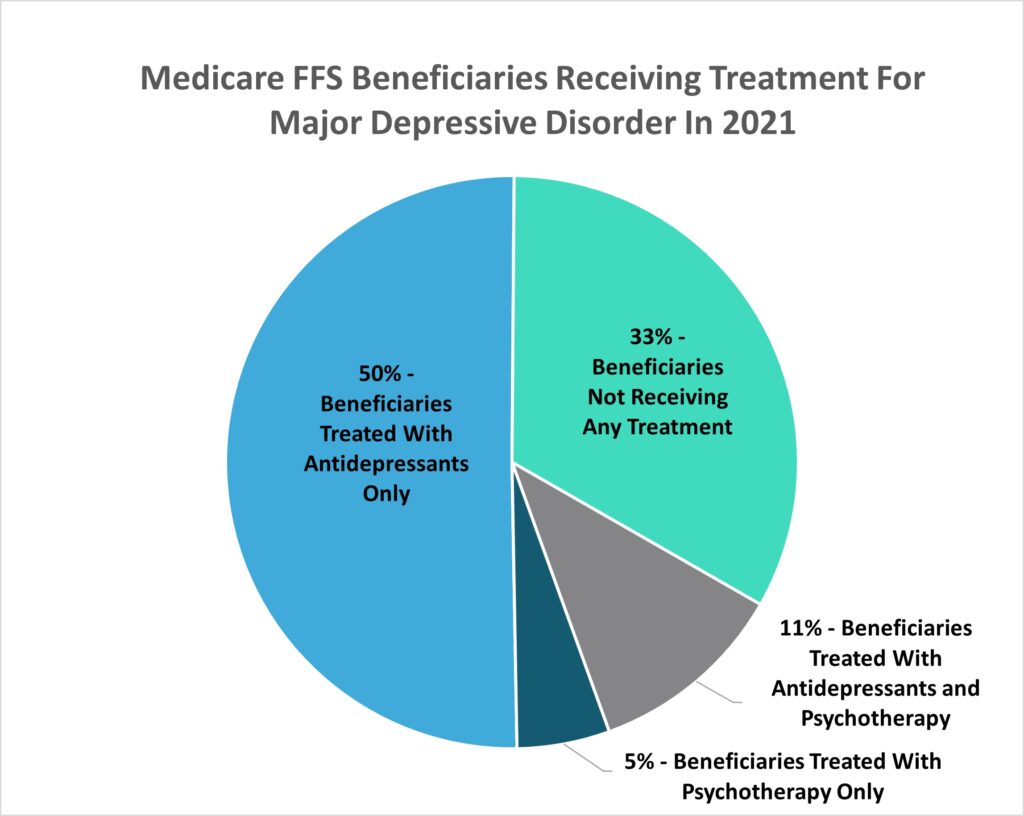
We found that 4,803,589 Medicare FFS beneficiaries had MDD using the Chronic Condition Data Warehouse (CCW). We then profiled the beneficiaries’ Parts A, B, and D claims to evaluate treatment for MDD. While 67 percent of beneficiaries were receiving care in the form of antidepressants or psychotherapy, nearly 33 percent were not receiving any treatment through Medicare.
In 2021, 80 percent of low-income subsidy (LIS) beneficiaries received treatment for MDD compared to 61 percent of non-LIS beneficiaries. Black beneficiaries were the least likely to receive treatment (60 percent of patients) and had the lowest utilization anti-depressants (41 percent) but the highest utilization of psychotherapy (8 percent). Hispanic beneficiaries were the most likely to receive treatment (69 percent) and had the highest utilization of anti-depressants (52 percent). White beneficiaries made up the highest proportion of the MDD population (87 percent).
Get in touch to learn more about how we can help you evaluate unmet needs with the treatment of MDD for Medicare beneficiaries.
*Source: NIMH » Major Depression (nih.gov)
Caitlin Sheetz, MPH
Senior Vice President and Head of Strategic Analytics, Value and Economics
CEO insights
Related articles
Real analysis from people who’ve been there

ADVI Health Accelerates Insights with Monthly Medicare Data
ADVI Health now has access to 100% of Medicare Parts A, B, and D research files with monthly availability – …

RAND/UCLA Modified Delphi Panels
ADVI Health partners with pharmaceutical and biotech organizations to advance their evidence generation and market access strategies. We support complex research questions through primary research (e.g., …
Caitlin Sheetz, MPH
June 23, 2026

The 2026 Rare Disease Reality
Orphan drugs now represent approximately 20 percent of total prescription spend, and over 52 percent of the cell and gene …

Marc Samuels, JD, MPH
February 26, 2026

How HEOR and Real-World Evidence Are Reshaping Decisions in 2026
By 2026, health economics and outcomes research (HEOR) and real-world evidence (RWE) will look less like a supporting function and …

2026 Life Sciences Forecast: AI, Next-Gen Cell & Gene Therapy, and Policy Disruption
In 2026, we expect the healthcare landscape to be defined by technology breakthroughs, market access disruption, and profound policy changes. …
Marc Samuels, JD, MPH
December 16, 2025

Delivering on CAR T-cell Therapy’s Promise: Policy Solutions for the Next Era of Cancer Care
CAR T-cell therapy offers a groundbreaking treatment option for patients with relapsed or refractory hematologic malignancies, yet access remains severely …

Alicia Silver, MPP
November 21, 2025

Real-World Effectiveness vs Clinical Trial Efficacy in Medicare
The Inflation Reduction Act (IRA) has ushered in a new era of drug pricing negotiations in the US. For the …
Why is Medicare Data Central to IRA Negotiations?
The Inflation Reduction Act (IRA), passed in 2022, has transformed the way drug pricing will be managed in the United …
Reach out
Own your edge
We don’t just guide the market. We shape it. Map your market access moves with #ADVIIntelligence. Proven advantage. Unmatched partnership.