
ADVI SAVEs Analysis: The Prevalence of Viral Hepatitis
Hepatitis is a viral infection that causes inflammation of the liver. In the United States, the most common types of Viral Hepatitis are Hepatitis A, Hepatitis B, and Hepatitis C. In 2020, there were an estimated 19,900 people with Hepatitis A, 80,000 people with Hepatitis B, and 2.2 million people with Hepatitis C. (Source: What is Viral Hepatitis? | CDC)
ADVI Health’s Strategic Analytics, Values and Economics (SAVEs) team wanted to better understand the prevalence of Viral Hepatitis among Medicare fee-for-service (FFS) beneficiaries and their average cost of care.
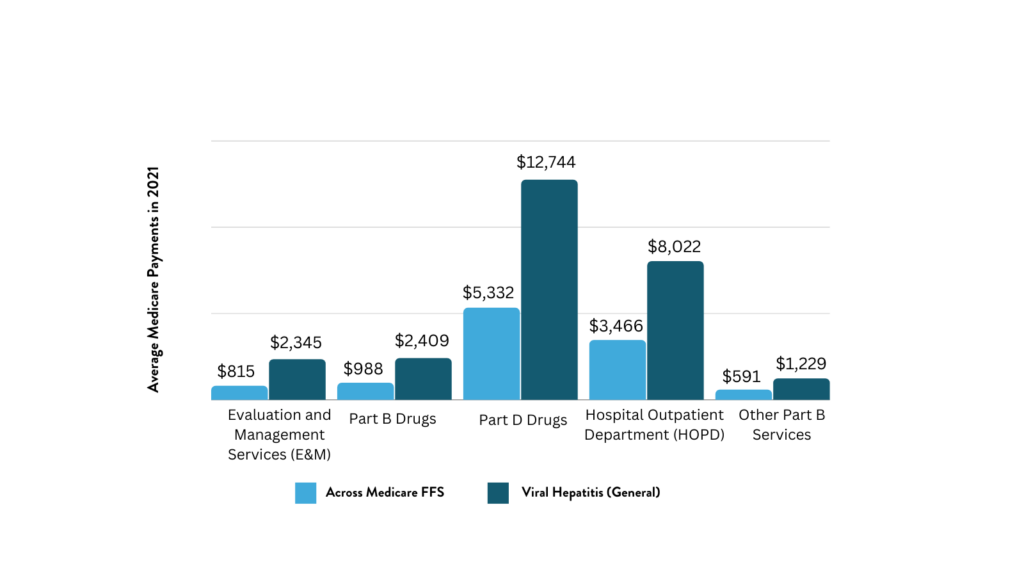
In 2021, we found 249,529 (0.7 percent of all Medicare beneficiaries) patients with Hepatitis using the Chronic Condition Data Warehouse (CCW) Chronic Conditions File. The average Medicare spending for patients with Hepatitis was three times more than the average spending of the Medicare FFS population ($44,572 vs $14,805). Figure 1 shows the Top five services with the highest average Medicare spend in 2021. The increased spending was mainly Evaluation and Management (E&M) payments and Part B and D drug spending.
This population skewed toward lower-income beneficiaries as 50 percent were low-income subsidies (LIS) and 48 percent were dually eligible for Medicare and Medicaid. Both numbers are significantly higher than the general Medicare Fee-for-service (FFS) population which are 17 percent and 16 percent respectively.
Figure 1 – Top Five Services with the Highest Average Medicare Spending in 2021.
CEO insights
Related articles
Real analysis from people who’ve been there

ADVI Health Accelerates Insights with Monthly Medicare Data
ADVI Health now has access to 100% of Medicare Parts A, B, and D research files with monthly availability – …

RAND/UCLA Modified Delphi Panels
ADVI Health partners with pharmaceutical and biotech organizations to advance their evidence generation and market access strategies. We support complex research questions through primary research (e.g., …

Caitlin Sheetz, MPH
June 23, 2026

The 2026 Rare Disease Reality
Orphan drugs now represent approximately 20 percent of total prescription spend, and over 52 percent of the cell and gene …

Marc Samuels, JD, MPH
February 26, 2026

How HEOR and Real-World Evidence Are Reshaping Decisions in 2026
By 2026, health economics and outcomes research (HEOR) and real-world evidence (RWE) will look less like a supporting function and …

2026 Life Sciences Forecast: AI, Next-Gen Cell & Gene Therapy, and Policy Disruption
In 2026, we expect the healthcare landscape to be defined by technology breakthroughs, market access disruption, and profound policy changes. …
Marc Samuels, JD, MPH
December 16, 2025

Real-World Effectiveness vs Clinical Trial Efficacy in Medicare
The Inflation Reduction Act (IRA) has ushered in a new era of drug pricing negotiations in the US. For the …
Why is Medicare Data Central to IRA Negotiations?
The Inflation Reduction Act (IRA), passed in 2022, has transformed the way drug pricing will be managed in the United …
PHAR Partners Present at the National Bleeding Disorders Conference
Jonathan James, patient and patient advocate for a hemophilia advocacy group, partnered with PHAR (Partnership for Health Analytic Research) and …
Reach out
Own your edge
We don’t just guide the market. We shape it. Map your market access moves with #ADVIIntelligence. Proven advantage. Unmatched partnership.